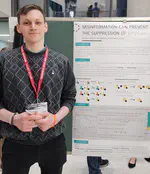
Over 7 years of research experience, leveraging data analysis and high-performance computation to develop stochastic models of complex real-world systems. Notably, developed methods to derive underlying stochastic differential equations from multidimensional data sets. Proficient in Python, C++, MATLAB and R. A team-worker and highly motivated to drive insights and innovation at the intersection of mathematics, data science, and quantitative research.
Currently, a Research Fellow at UCL, developing mathematical models for the evolution of antimicrobial resistance (AMR) in heterogeneous environments. Previously, obtained a PhD and an MRes in Statistical Applied Mathematics from the SAMBa CDT in Bath, a MSc in Physics at the São Paulo State University (UNESP), and a BSc in Physics at the University of São Paulo (USP).
In my free time, I am honing out my skills in Data Science, reading, hiking or learning a new language.
- Interacting Particle Systems
- Collective Behaviour
- Stochastic Processes
- Financial Markets
- Data Science
PhD in Statistical Applied Mathematics, 2024
University of Bath
MRes in Statistical Applied Mathematics, 2021
University of Bath
MSc in Physics, 2020
ICTP-SAIFR / UNESP
BSc in Physics, 2017
Universidade de São Paulo